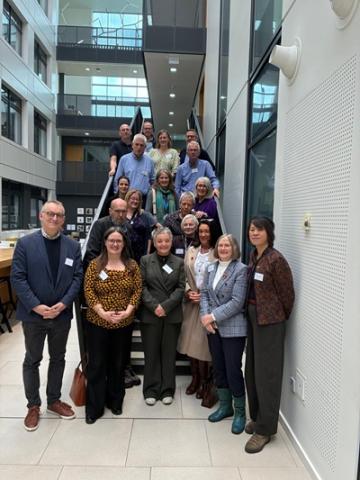
A cross-party group of MSPs have visited the University of Dundee to witness internationally recognised Parkinson’s disease research and hear from the patients contributing to this work.
The MSPs were invited to the University’s Faculty of Life Sciences by the Dundee Research Interest Group (DRIG), an organisation comprising people who have Parkinson’s, or have a partner, family member or friend with the condition. The group brings together Parkinson’s researchers and clinicians with those living with the condition to exchange knowledge, ideas and hope.
Taking part were MSPs Heather Anderson (Dundee City West), Dawn Black (Angus North), Yi-Pei Chou Turvey (North East Scotland), Joe Long (Mid Scotland and Fife), Helen McDade (Mid Scotland and Fife), and Julie MacDougall (Mid Scotland and Fife).
They were given a tour of the Medical Research Council Protein Phosphorylation and Ubiquitylation Unit (MRC-PPU), where much of Dundee’s Parkinson’s research takes place as well as meeting members of DRIG to hear their personal stories about how the disease has affected them. Many of the members are currently or have in the past been involved in Dundee-led clinical trials which could prove transformative for patients.
Ms Anderson, a member of the Scottish Parliament’s Health, Sport and Care Committee, said, “Sixty people from 30 different countries are carrying out world-leading research into Parkinson's disease at the University of Dundee. This is an extraordinary story of ground-breaking science, cutting-edge researchers, and international collaboration, achieving incredible results in the city of discovery.
“Dundee is at the heart of global efforts to better understand, and ultimately cure, Parkinson's disease. Every Dundonian should take great pride in this.”
Parkinson’s disease is the second most common neurodegenerative condition after Alzheimer’s. Around 14,000 people in Scotland live with Parkinson’s, with approximately 30 new diagnoses made each week. It is predicted that there will be a 50% rise in the number of people aged over-60 – the group most likely to experience Parkinson’s – by 2033, while there has also been a distinct rise in diagnosis of early-onset (or young-onset) Parkinson's disease.
Despite this, the last drug that has been of any benefit to those with the condition was discovered in 1967. At a fundamental level, Dundee scientists are working to understand why brain cells degenerate and how this knowledge can be translated into better diagnostics and disease-modifying therapies.
This work focuses on key proteins where inherited genetic mutations provide powerful insights into the biological pathways underlying both rare familial and far more common sporadic forms of Parkinson’s disease.
This approach has been driven by Professor Dario Alessi, Director of the MRC-PPU, whose research focuses on a gene called LRRK2, the most frequent cause of inherited Parkinson’s.
His colleague Professor Miratul Muqit is Director of the UK DRI Parkinson’s Research Centre, headquartered in Dundee, while Dr Esther Sammler, who leads multiple international academic and industry-sponsored clinical trials, was recently named winner of the prestigious Tom Isaacs Award in recognition of her Parkinson’s research.
DRIG has members from Perthshire, Fife, Dundee and Angus, and is one of 14 research interest groups supported by Parkinson’s UK, and one of four in Scotland. By working together, people with Parkinson’s, their families, scientists and health professionals can develop the most relevant research projects and the most effective trial designs.
DRIG Secretary Joanna Goodburn said, “With my maternal grandmother, father and husband all hit by this horrid condition, trying to understand more about what is happening inside their brains and how it might be treated is a really important support mechanism for me as well as my husband.
“These amazing researchers in Dundee are leading a huge global network of Parkinson’s scientists gathering vital information from people with Parkinson’s to help lead them to the answers they need about the causes of Parkinson’s. This information will, we all hope, provide the pathway to a cure. Scotland should be rightly proud of its ability to attract to Dundee some of the world’s most distinguished researchers in the field and impressive Michael J Fox Foundation funding for this global project.”
Anyone with a Parkinson’s diagnosis who would like to find out more about DRIG can access further information visit drig.org.uk/ or email secretary@drig.org.uk