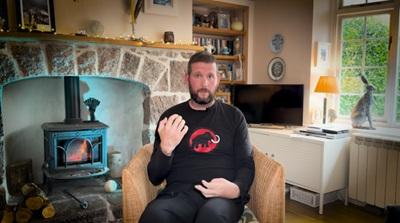
The University of Dundee is a world-leading centre for thrombectomy training, helping more clinicians deliver life-saving stroke treatment and improving patient outcomes worldwide. A new video launched today explains why Dundee-based experts are driven by the desire to help patients like Graham McGowan.
Graham is a victim of both geography and timing. That much was spelled out to him in Aberdeen Royal Infirmary in the aftermath of him suffering a major stroke.
“The consultant said to me ‘if you'd been here at 3 o’clock this afternoon, we'd have popped you in a helicopter and flown you down to Dundee for a thrombectomy’,” explained Graham. “At the time I had probably not a single clue what it meant. I have a better idea now.”
Graham was only 49 when a small tear in his carotid artery sent a clot to his brain, triggering a stroke, at home in Aberdeenshire in 2022. The life-changing moment took place at around 9pm, outside the hours when his nearest specialist thrombectomy service – some 70 miles away – was open. It was a bolt from the blue for the fitness enthusiast who loved the outdoors and his wife Heather. Graham’s story is told in this mini-documentary, in which experts from Dundee’s School of Medicine explain why they are so determined to improve the outcome for stroke patients.
Thrombectomy, which he heard of for the first time as he lay in his hospital bed, is considered the most effective way to treat patients whose stroke is caused by a large, blocked brain vessel but, in many parts of the world, less than 1% of patients receive this life- and brain-saving treatment. The situation is complicated by the lack of specialist thrombectomy centres and trained neuro-interventionists to perform the procedure. There are only three such facilities in the whole country and Dundee is the most northerly of these, meaning that patients from as far away as the Shetland Isles face poorer outcomes as a result.
“Time equals brain in stroke,” says Professor Iris Grunwald, Chair of Neuroradiology and Director of the University’s Image Guided Therapy Research Facility (IGTRF). “Every six minutes delay in receiving treatment equates to a 1% lesser chance of a good outcome.”
It was Iris who set up the Stroke Thrombectomy Centre at Dundee’s Ninewells Hospital having established similar centres in Germany and in England. Expanding access to thrombectomy is her life’s work, and Iris passionately believes that training experienced clinicians from other disciplines – such as cardiologists, neurologists and vascular surgery – to perform thrombectomy is one of the best ways of ending the grossly unfair situation whereby a patient’s chances are determined by where and at when they experience stroke.
“For patients like Graham, timely treatment could have really made a difference, but there are just not enough neuroradiologist and neurointerventional centres available to provide treatment to all,” she continued. “Often these operators already have the skill set and have dealt with catheters and stent for years and it is absolutely possible to upskill them to perform thrombectomy procedures.
“To my knowledge we are the only place in the world that offers this comprehensive cross speciality training model and so far have changed the lives of thousands of patients for the better.”
Dr Helen Routledge, a consultant cardiologist in Worcestershire, says she wants accreditation to perform thrombectomy but that resistance to the idea of non-specialists performing the procedure has prevented her from doing so. “I want to help the patients and feel like I've got the skills to be able to do that, but there's been so many hurdles along the way I have almost given up,” she said.
Dundee is now the official global training centre for the World Federation for Interventional Stroke Treatment (WIST), training teams from many specialities and from across the world. This has led to the establishment of specialist thrombectomy services in 11 countries.
The thousands of patients across the globe that Iris referred to have benefitted from the optimum treatment that Graham missed out on. As he explained, missing out on timely treatment has had a devastating effect on his life.
“I was pretty fit,” he said. “I was a keen runner. I love running in the hills and hill walking and mountain biking and skiing in the winter time. All things that I can't do any more. I would love to be able to run again, but I think realistically if I could walk better I would be happy and I'd really love for my arm to come back a bit. I think my fine motor skills are going to be a long way away, unfortunately. But it would be great to have movement in my wrist and my fingers because at the moment they just don't work at all.
“You just can't do anything on the spur of the moment. You’ve got to remember this is Heather's life that’s been completely turned upside down as well.”
Dr Michelle Cooper, Operations Support Managers at IGTRF, said that Dundee has been a global test bed, proving that the model of training clinicians from disparate backgrounds work and giving hope to patients around the world who do not realise yet that the fact and quality of their lives depend on access to thrombectomy.
“Dundee was one of the first centres to train operators from different specialities on thrombectomy,” she said. “Scotland has proved it works. Now it must grow so every patient in every corner of the country can access this life changing treatment that others already can.”
That sentiment is shared by Dr Paul Guyler, Director of the East of England Stroke Service, who said, “It does seem to me counterproductive when we have expertise that can set up services which are safe and effective, that we're not taking full advantages of looking to optimise all the opportunities that are available in the United Kingdom. We've got to make a difference for patients.
“Something has to change. In 2019 the the plan was to fully roll out thrombectomy for 10% of the population by 2022 and by 2022 we got to about 2.8%. There's been very slow progress in the UK whilst the team in Dundee has trained centres worldwide and teams in Germany, Poland, Kenya, South Africa and Argentina.”
To Iris and her colleagues, the potential consequences of stroke are such that ensuring more clinicians are trained to perform thrombectomy should be a major healthcare policy priority.
That is a position that Graham agrees with after three years of gruelling physical therapy to get him to where he is today.
“Even though I'm still not in a very good physical situation, I'm definitely a lot better than I was,” he said. “I've actually come quite a long way from being unable to walk to where I am now. And my life is not misery now either. It's difficult and challenging and not the easy life that maybe was before, but it has quality in it still.
“If it happened to me, then in some ways it could happen to anybody. You've got to try and put yourself into that situation and go imagine that happened to me. ‘Could I deal with a situation that Graham finds himself in?’. If the answer to that is maybe not, then do something about it.
“If thrombectomy is there and it would prevent somebody else from having to go through this situation, then let's get it done. Let's get it funded and let's get people trained to get to do the procedure. It's got to be worthwhile.”
For more information about stroke training at Dundee, contact IGTRF@dundee.ac.uk or visit https://www.dundee.ac.uk/campaigns/expanding-access-life-saving-stroke-thrombectomy.