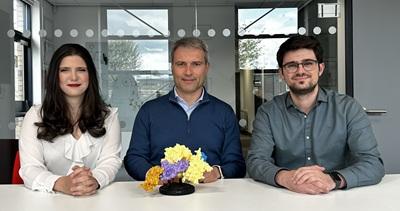
Cancer drug design could be transformed following a breakthrough collaboration between the University of Dundee and Austrian Academy of Sciences.
Scientists at Dundee’s Centre for Targeted Protein Degradation (CeTPD), the CeMM Research Center for Molecular Medicine of the Austrian Academy of Sciences, and the Vienna-based AITHYRA Research Institute for Biomedical Artificial Intelligence have discovered a new class of small molecule that can simultaneously hijack two separate cellular machineries to destroy a cancer-driving protein. By effectively outsmarting the drug resistance abilities of protein, it creates a new opening for drug designers to exploit in the battle against cancer.
The findings have been published in the journal Nature Chemical Biology.
Professor Alessio Ciulli, Director of the CeTPD, said, “This is an incredibly important development. The structural detail we have been able to obtain here is remarkable.
"We can see precisely how this small molecule creates a new molecular handshake between proteins that would not normally interact. Because we can chemically tune which enzyme is doing the heavy lifting, medicinal chemists have a new avenue to explore when designing the next generation of cancer drugs.
"This work is another example of how Dundee's leadership in targeted protein degradation continues to push the boundaries of what we thought was chemically and biologically possible. The collaboration between our groups has once again proven to be a powerhouse for fundamental discovery."
Existing degrader molecules, including the class known as molecular glue degraders (MGDs), typically work by recruiting a single enzyme of a class called E3 ubiquitin ligases to tag and destroy a target protein. A key vulnerability of this approach is that cancer cells can develop resistance by mutating or downregulating that single E3 ligase, causing the drug to stop working.
This new study, led jointly by Professor Ciulli and Dr Georg Winter at AITHYRA, demonstrates for the first time that a single, compact monovalent degrader molecule can recruit not one but two entirely distinct E3 ligases simultaneously to destroy the same target protein. The target in this case is a protein known as SMARCA2/4, which is frequently mutated in cancer and considered a high-priority therapeutic target.
Using a powerful combination of genetic screening, structural biology including cryo-electron microscopy, and biophysical and chemical tools, researchers discovered that the compound engages its primary E3 ligase - DCAF16 - locking the two proteins together. The team were then able to show that the molecule's preference between DCAF16 and a second E3 ligase (FBXO22) can be switched simply by making minimal chemical modifications to the compound.
The research builds on the rapidly advancing field of targeted protein degradation, in which small molecules are used to redirect the cell's natural waste-disposal system to destroy disease-causing proteins.
"What we have discovered here is genuinely unprecedented," said Dr Georg Winter, Scientific Director at AITHYRA.
"Until now, all molecular glue degraders that have been described work through a single E3 ligase. We have shown that even if a cancer cell loses one of the ligases — a well-known route to drug resistance — the other ligase can still do the job. This opens an entirely new design principle for more resilient degrader drugs."
Photograph of Professor Alessio Ciulli (centre) and co-first authors Valentina Spiteri (left) and Alejandro Correa-Sáez (right). Credit - University of Dundee